i was just talking to a friend about how we have to have this conversation every single quarter that we teach, so i pass it on to you. shakespeare is not old english! chaucer is not old english!!
old english
also called anglo-saxon
in use from around 400 to around 1066 (the norman conquest) in england and parts of scotland during the early middle ages.
“Hwaet, we gardena in geardagum, þeodcyninga þrym gefrunon, hu ða æþelingas ellen fremedon!”
if it looks like it could be the name of a field or military group in Rohan, it’s probably OE
middle english
in use from 1066 to the early 1500s (along with french & latin) during the late middle ages.
most popular example: chaucer’s canterbury tales (see it written)
A knyght ther was, and that a worthy man, That fro the tyme that he first bigan To riden out, he loved chivalrie, Trouthe and honour, fredom and curteisie…”
will have recognizable words. read it out loud if you’re struggling.
still no standardized spelling. or dictionaries. soz. we’re getting there.
just straight-up regular english
in use from the 1500s until now.
that means shakespeare and james joyce and jk rowling are all grouped under the same language umbrella
reread that. shakespeare is tough and uses english differently than we’re used to, but he is not old english! he is, for the purposes of labelling, modern english.
if you are feeling super picky you can label his work as “early modern english” (”early modern” being the period between 1500 and 1700ish) but tbh that’s a fairly arbitrary distinction.
Identifying texts from around 1500-1700 as early modern is fairly standard within academic circles. This is because, despite Shakespeare’s English more closely resembling our own, there was still a great deal of variety in the ways in which words were spelled. Shakespeare, of course, is so popular, that his works are widely available in modern English and with modern punctuation (though it’s worth noting that punctuating Shakespeare is still an ongoing critical debate.) For example, in the First Folio of Shakespeare’s plays, the famous couplet from Claudius—"My words fly up, my thoughts remain below. / Words without thoughts never to heaven go.“—appears as, “My wordes fly vp, my sinnes remaine below. / No King on earth is safe, if Gods his foe.” This example highlights the spelling and editorial revisions which have since gone into making Shakespeare sensible to “modern” audiences. Moreover, early modern texts are also contemporaneous with what is commonly referred to as the “great vowel shift"—the period in which the pronunciation of English vowels changed drastically. What this means is that, whereas you might recognise Shakespeare’s English more easily than, say, Chaucer’s, you wouldn’t understand Shakespeare’s English if you were to hear it out loud. The Globe Theatre periodically does OP (original pronunciation) productions and they’re worth checking out if you’re curious.
yes!! this is such a great addition, thank you! yall, reading in the original is so, so important – and it’s easier with early modern texts than with medieval ones. if you have database access most things are centrally available on EEBO, and both the folger and the bodelian have digitized versions of shakespeare’s first folio that are worth checking out. don’t settle for reading the results of late editorial decisions you didn’t make!
also on the distinction between old and middle english– there are, of course, gradations, as one would expect when trying to periodize a thousand years into two neat linguistic partitions. as time passes, our notion of middleness shifts inevitably to the right, for better or for worse. with old and middle english the distinction is almost neat, as the norman conquest created some very deep and abiding changes in the language (the change from “cyning” to “king,” as evinced in the later sections of the anglo-saxon chronicle, is a notable example), but there are still marked shifts over time– though old english is the form of english that least resembles our modern language, there are sections of the a-s chronicle that can be read much like modern English thanks to case collapse and syntax shift. old english comes with a different alphabet which includes ð, þ, and æ; different syntax; a case system; vastly different vocabulary– as well as so many words that are just a letter or two away from their modern derivatives–; dialects and variation; and pronunciations that feel simultaneously foreign and so familiar. and all this nuance is of course lost with the words “old english? what, like shakespeare?”
100%, all of the above. also i edited the original post (a few minutes after it took off, unfortunately) to add that middle english looks & sounds very different depending on where it’s written/spoken – gawain and the green knight, for example, looks very different from the canterbury tales, in large part because the gawain author is from the north and chaucer wrote from london.
ALSO a Very Important Medieval Fact is that “ye,” as in “Ye Olde Shoppe,” is NOT A THING. not a thing, folks!! the letter thorn (þ) was pronounced “th” and often looked very similar to the letter “y” – some scribes didn’t even distinguish between them. when the press happened, “the” was mostly written with a “th,” but sometimes rendered as
“þ” with a superscript “e”; eventually thorn phased out and got replaced by “y” (probably because that was one less piece of type for printers to deal with). so “ye olde shoppe” is actually just “the olde shoppe.” now you know~~
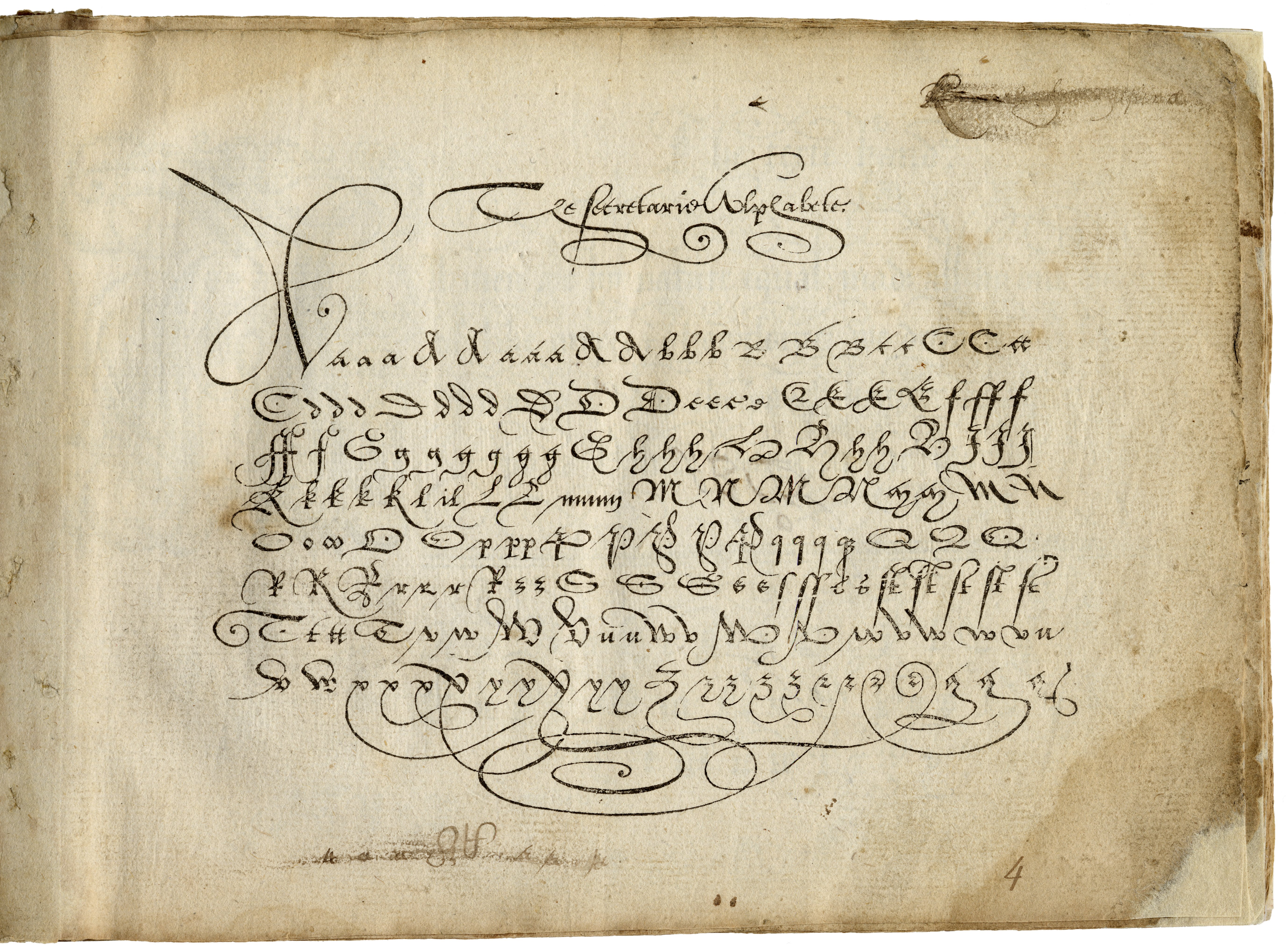
Just adding to the early modern English thing: let me introduce you to a wonderful little thing called secretary hand. Basically it’s an early form of what we all know as ‘cursive’ or ‘joined up’ writing–it was used to write efficiently and legibly. But there was still a load of variation and some of the letter forms are absolutely unrecognizable today, so it can be really confusing to read. In our first secretary hand workshop this year we had to basically re-learn the alphabet and it took us literally two hours to decipher a marmalade recipe. Here’s why:
Here’s the trickiest part: minims. Minims are little teeny dashes used to indicate small letters like m, n, u, v, w, etc. Problem is, when you get a bunch in a row it can be really hard to work out how many letters are actually there and what they are. The word “minimum,” for example, would b a nightmare. Here’s another example of the secretary hand alphabet from the Folger Shakespeare library. If you look in the middle of the fourth row you’ll see the minims, in between the big fancy Ls and Ms:
So that’s an extra little tidbit about early modern English.


 Site Title